The man in 10B was short with dark hair. He looked vaguely familiar, like that kid in the back of your middle school math class.
He sat down and I realized that I was sitting next to Bozidar Delic (Božidar Đelić), the Vice-Prime Minister of Serbia and minister in charge of Science and Technological Development. One of the most powerful men in Serbia.
I am impressed that this man, whom I met briefly in his office a few months ago, flies economy without a bodyguard or entourage, and, to a lesser extent, that he remembers what I am working on (a small project in a politically crucial city, but a small project nonetheless).
May 31, 2011

February 01, 2011
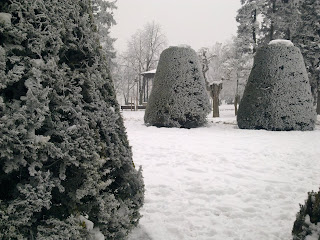
Kalemegdan Park, Belgrade
It was bitterly cold (-12°C) and rime had formed on every tree and bench in the park. In the summer, the place is teeming with people, but we were nearly alone to cross it on foot a few days ago.




May 29, 2010
Back to Sukkur
I went back to Sukkur for another mission. This time, I got to spend a few days there.
One of things that I was asked to do was to attend a formal ceremony at which we were fed a boxed lunch. The box is actually a recycled cereal box, and when you open it you see what was formerly on the outside. This is the second time that it's happened, so I suspect that it's common practice.
 There is an old fort on the Indus River in Sukkur, it's on an island and so the river looks only half as wide as it normally is. Because it was incredibly hot (over 45°C/113°F), boys were swimming in the river.
 as were buffaloes
 On of the problems facing Sukkur is the lack of appropriate solid waste collection. Thankfully, goats and sometimes cows consume a fair amount of the organic material.
 The other animal that you see a lot around is the donkey. There are many donkey carts that people will carry all manners of stuff on.
 Water supply in Sukkur is not sufficient, so people have installed hand-pumps from which they draw underground water. On the picture below, you also see another classic: the open manhole (very dangerous).
 In this picture, you see an ad-hoc water supplier (using a tanker) getting water from a canal in which cows are having a dip. The cows are upstream of the tanker... (sorry about the blurry motorcycle in the front, I was in a moving car).

This fire fighting equipment was seen at a petrol station.
 Whereas most women in Karachi and Lahore will wear a hijab or no veil at all (one can also see a few niqabs), there is a significant number of women in Sukkur and the surrounding area who will wear yellow burqas such as the one below. I didn't see any black or blue ones. I wonder if there is a significance to the color or not. There are also very few women in the streets, as compared to Karachi or Lahore.
 In addition to the old fort, Sukkur has a few nice buildings, including this mosque.
 As everywhere else in the developing world, those who can afford it have a bicycle, and will ride it even in the punishing heat.
 Another option for transport is these overcrowded minibuses. Without air conditioning and room to move, I think I might prefer a bicycle.
 Around Sukkur, some traditional houses are made with reeds from the banks of the Indus and the many canals that criss-cross the region.
 There are also dozens of brick factories such as this one. Notice the date palms in the back, which the region is famous for. Don't be fooled by the electrical wires, power is available only a few hours a day, as load shedding is prevalent (the cause of the lack of electricity appears to be in part a dispute with India over water, on which I have no opinion).
 In the poorest part of Sukkur, the roads aren't paved, which leads to puddles of sewage in the streets. You can also see a small flock of goats, a donkey cart, and two tuk-tuks.

January 26, 2010
Ethiopian Airline crash
The tragic plane accident that recently occured off the coast of Lebanon (25 Jan 2010) should, one would hope, be reported on evenly in both the French and US press. Unfortunately, I was not surprised to notice the difference in reporting. Don't get me wrong: the facts are exactly the same, as is the pathos conveyed in the piece. What differs, however, is where the make of the doomed plane is mentioned.
Excerps are from the very first word in the article.
In Le Monde dated 25.01.2010 (emphasis mine) :
Un Boeing 737 d'Ethiopian Airlines avec 90 personnes à bord s'est abîmé au large du Liban, lundi 25 janvier vers 2 heures, heure locale (1 heure, heure de Paris), peu après son décollage de Beyrouth. Les équipes de secours libanaises qui participent aux recherches sur le site de l'accident avaient retrouvé dix corps lundi matin. "Jusqu'ici, nous avons retrouvé dix corps sur le site du crash au large des côtes de Naameh, [à environ 12 km] au sud de Beyrouth", a indiqué un responsable du ministère de la défense sous le couvert de l'anonymat.
see the entire article here: http://www.lemonde.fr/proche-orient/article/2010/01/25/catastrophe-aerienne-en-mediterrannee_1296109_3218.html
-----------------------------------------------------------------------------------------------
In the New York Times online edition, dated: January 24, 2010
An Ethiopian Airlines plane crashed into the Mediterranean Sea on Monday morning shortly after it took off from Beirut International Airport in stormy weather. Officials said that 82 passengers and 8 crew members were on board. “The flight lost contact with Lebanese air traffic controllers shortly after takeoff,” said Wogayehu Terefe, a spokeswoman for Ethiopian Airlines. She added that a rescue crew was headed to the crash site to see if anyone had survived.
I've long had a theory about this, namely that the French press will bury the name Airbus deep in an article while the US press will do the same with Boeing, and that the French press will lead with the name Boeing while the US press will lead with Airbus, depending on the case.
Should I be disappointed? perhaps a little bit, but I am also not surprised in the least.
Excerps are from the very first word in the article.
In Le Monde dated 25.01.2010 (emphasis mine) :
Un Boeing 737 d'Ethiopian Airlines avec 90 personnes à bord s'est abîmé au large du Liban, lundi 25 janvier vers 2 heures, heure locale (1 heure, heure de Paris), peu après son décollage de Beyrouth. Les équipes de secours libanaises qui participent aux recherches sur le site de l'accident avaient retrouvé dix corps lundi matin. "Jusqu'ici, nous avons retrouvé dix corps sur le site du crash au large des côtes de Naameh, [à environ 12 km] au sud de Beyrouth", a indiqué un responsable du ministère de la défense sous le couvert de l'anonymat.
see the entire article here: http://www.lemonde.fr/proche-orient/article/2010/01/25/catastrophe-aerienne-en-mediterrannee_1296109_3218.html
-----------------------------------------------------------------------------------------------
In the New York Times online edition, dated: January 24, 2010
An Ethiopian Airlines plane crashed into the Mediterranean Sea on Monday morning shortly after it took off from Beirut International Airport in stormy weather. Officials said that 82 passengers and 8 crew members were on board. “The flight lost contact with Lebanese air traffic controllers shortly after takeoff,” said Wogayehu Terefe, a spokeswoman for Ethiopian Airlines. She added that a rescue crew was headed to the crash site to see if anyone had survived.
Of the 90 people aboard the flight, more than half - 51 people - were Lebanese nationals. The airline also said that 23 passengers were Ethiopian. Two British nationals were also listed as passengers, and the remaining six passengers were Turkish, French, Russian, Canadian, Syrian and Iraqi nationals, the airline said. The eight crew members were Ethiopian.
The plane that crashed, Ethiopian Airlines Flight 409, was a Boeing 737 that had been scheduled to take off at 2:10 a.m., according to the company’s Web site, but it actually left at 2:35. The 1,730-mile flight to Addis Ababa, Ethiopia’s capital, was scheduled to take 4 hours and 40 minutes.
See the whole article here: http://www.nytimes.com/2010/01/25/world/middleeast/25crash.html?ref=world
I've long had a theory about this, namely that the French press will bury the name Airbus deep in an article while the US press will do the same with Boeing, and that the French press will lead with the name Boeing while the US press will lead with Airbus, depending on the case.
Should I be disappointed? perhaps a little bit, but I am also not surprised in the least.
September 18, 2009
Animals
Domesticated animals are part of the ecology of the road, and can sometimes cause traffic jams as they cross.
Pakistanis are Muslims (for the most part) and so they eat beef, but they also consume milk. You see guys on motorcycles with old-fashionned metal canisters driving around. Here is a guy driving his cows (notice the short round horns on the black one):
 Between Hyderabad and Sukkur, you're crossing what's essentially a giant desert oasis (more pictures of that elsewhere). And the desert, there are camels, or in fact, dromedaries.


Road danger
The road is dangerous. Not because there is anybody out there to get you (if there is, I didn't see them), but rather because people tend to drive recklessly and at high speed. Vehicles are often overloaded and weave continuously, trying to go forward as quickly as possible. Sometimes, accidents happen (notice the decorated bumper)...
 Overloading is a bit of a national sport (right after cricket of course)
 And it can be done with either goods or people...
 This car is driving about 60-70 km/hr (the one with the people standing)
 Four people on a motorbike, and no helmet in sight.

 Overloading is a bit of a national sport (right after cricket of course)
 And it can be done with either goods or people...
 This car is driving about 60-70 km/hr (the one with the people standing)
 Four people on a motorbike, and no helmet in sight.

Back from Sukkur
I visited Sukkur, in northern Sindh province, as part of my trip here. I was taken around the town and somewhat astonished by what I saw, but have few pictures to show as my camera malfunctioned once I got there.
Instead, since I drove there from Karachi (8 hours), I have some pictures from the road, where the buses, trucks, private vehicles, and animals live in an incredible and somewhat precarious high speed equilibrium. The road itself will soon be improved, and the scenery was interesting. Unfortunately, most pictures are taken from a moving car and through windows, and so they are not very good, but they illustrate the journey sufficiently.
The trucks that seem to ferry an infinite variety of goods among the highway are colorful and beautifully and intricately decorated. This one is from the toll in Sukkur. Note that the entire truck is decorated, including the bumper.
 Another truck along the road in the irrigated part of the Indus plain. Note the motorcycles on the highway.
 Another truck
 The peacock (or is it a partridge) is a common symbol. Perhaps it has some religious or national significance, but I am not aware of it. Note the decorations down to road level...
 Some trucks are decorated with human figures.


Apparently, even the interior of the trucks is decorated, so that they are still stunning when they are empty.
 A nice side view of a heavily loaded, and completely decordate truck, including the cab.
 More peacocks/partridges.

September 15, 2009
From Karachi
I am in Pakistan for a short trip . I have not had much of an opportunity to take pictures, but I have already been to Lahore and Karachi.
Lahore seems like a fairly peaceful city, and in the nice parts, is extremely leafy and clean. Old trees line the roads, which are in good condition. Our friends welcomed me in their home in the suburbs, where an amazing collection of kitchy developments has been laid to house the professional masses. The city itself has fairly low density. I will try to take pictures when I return later in the week.
This is a picture of the entrance to a development in suburban Lahore. Not far from this is something called Trafalgar Sq, I'll let you guess what it looks like...

Besides the brightly colored buses and the occasional donkey cart, there is nothing out of the ordinary about either Lahore or Karachi. There is the same nice villas, the same decrepit buildings, same beggards, bicycles, and tuk-tuks, same Range Rovers, servants, and armed guards, etc... that you might expect in similar cities around the world. Once thing that is amazing about both places, though, is the shear size: Karachi has 14M people (at least)...
People here are incredibly friendly and business driven. They all mention how bad Pakistan's reputation is around the world and want everyone to know that it's undeserved. Frankly, with what I've seen so far, I agree. I was invited to iftar to break fast, and met some very nice, highly cultivated and intelligent individuals. Of course, there is the occasional anti-zionist diatribe, and the jabs at the US and India, all within the confines of polite discourse and utmost respect for one's guest (that would be me).
Oh, and one more thing, once you have been to Lahore and Karachi, you know why NYC cabbies drive like they do...
July 29, 2009
More Belgrade
At night, the crowds are out in the pedestrian strees outside my hotel. Apparently, there are even more people when it's not vacation time.
 The old castle from a boat restaurant on at the confluence of the Sava and Danube.
 Decrepit apartment building on Parliament Sq.
 Parliament. Clearly, the Serbs are not afraid of car bombs, since you can park you car right under the windows of the parliament. There is also no visible security - in fact, you don't see any police to speak of anywhere in the streets.
 Another church
 A theater/museum of some sort (frankly I have not idea what the building is but I thought it was cool)

July 28, 2009
Belgrade
I am in Belgrade for another work assignment. The city is suprisingly good looking without too many communist or war scars. The site, at the confluence of two major rivers (Sava and Danube), is quite stunning, and it's no wonder that it's been occupied since before the Romans showed up.
Without further ado, some photos.
There are some nice pedestrian streets in the center, near my hotel.
 Down some streets, you can see interesting mixes of architecture. Is this synchretic urban planning?
 My hotel, rather communist and drab looking, but actually passable.
 The confluence of the two rivers is a nice sight. On the hill from which the picture is a taken is an old fort.
 Part of the old fort.
 More parts of the old fort.


Oh, to live in a world that's not ruled by lawyers and the fear of liability!

A church (duh).
 More of the fort, with some nice yellow flowers.
 A weird looking building in the distance, and another one nearby. The mix of architectures in this city is really something.
 Someone who feels very strongly about Kosovo has tagged this all over town. Unfortunately, I can't tell what they are for or against (though the reference to 1389 makes me think they don't like Kosovo's independence).

Subscribe to:
Posts (Atom)